
This work is not made up.
Every framework in The Unfiltering is grounded in decades of research across psychology, neuroscience and human behaviour. Because trust matters more than trends.
Why I care about the evidence
I will be honest with you. A lot of personal development content is built on vibes.
Someone has a breakthrough. They write a book about it. They call it a method. And suddenly it is being sold as universal truth.
I did not want to do that.
The frameworks behind The Unfiltering did not come from research. They came from my own experience of having my life fall apart and having to figure out who I actually was underneath everything I had been performing.
But once I built them, I went and checked. And what I found is that the research has been saying the same things for decades. Psychologists, neuroscientists and behavioural scientists have been documenting exactly what I experienced, in clinical language that most people never see.
My job is to translate that into something you can actually use.
The story makes the idea human. The evidence makes it trustworthy. You deserve both.
Three frameworks. One complete system.
Most personal development frameworks address one question. HB addresses three.
Together they form a complete theory of identity recovery grounded in evidence.
You were not lost. You were covered.
In 1960, a British psychologist named Donald Winnicott described something he called the True Self and the False Self.
He observed that children who are not given space to express authentic responses develop a performed version of themselves as a survival strategy. The performance keeps them safe. But over time, the person loses track of which version is real.
This is not pathology. It is a completely rational response to an environment that required compliance, performance or emotional management to stay safe or stay loved.
Winnicott called it the False Self. I call it the Filtered Self.
The True Self Model maps how the layers accumulate over a lifetime, in roughly the order they form:
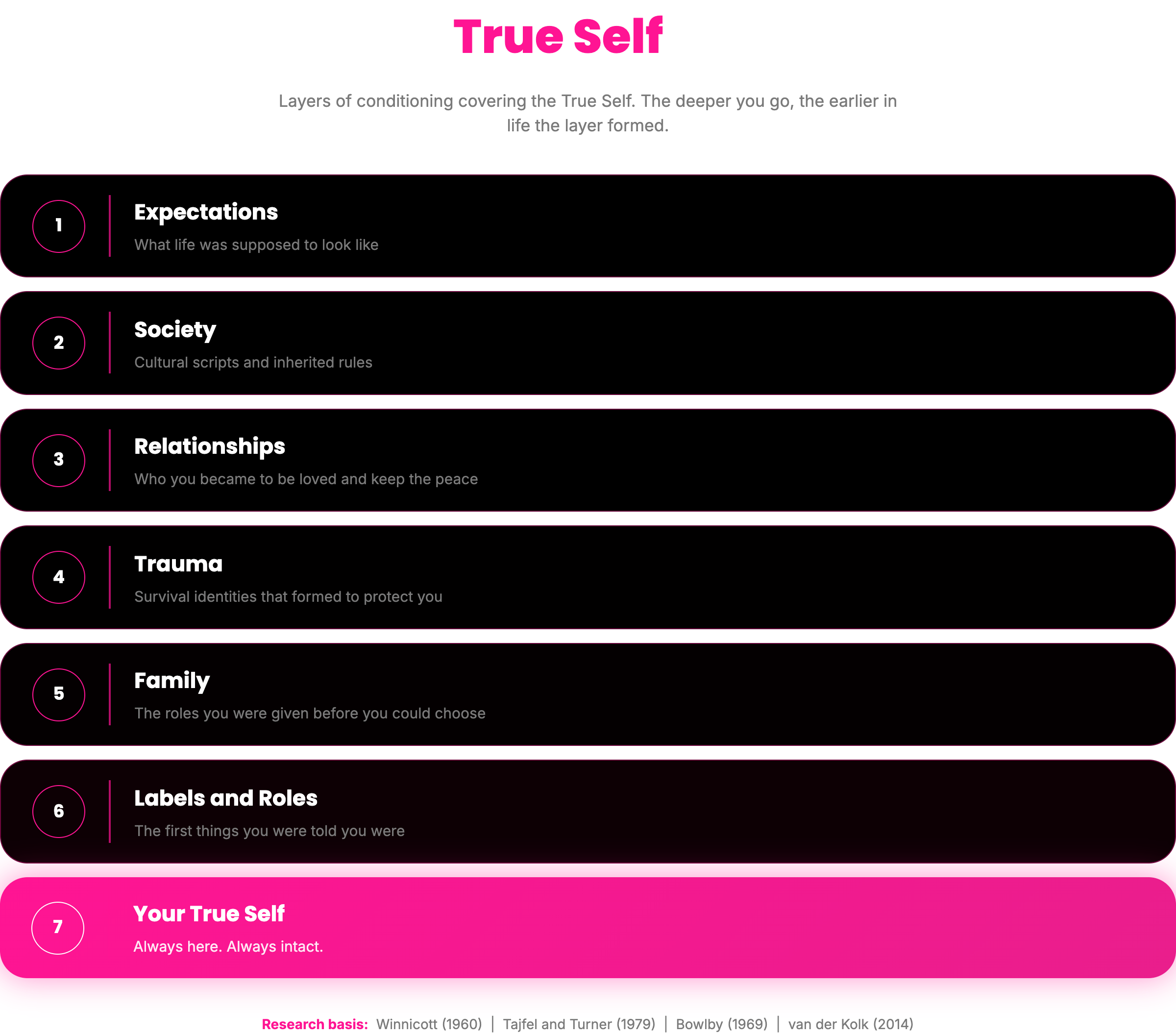
Under all of it: your True Self. Always there. Never actually lost.
The work is not to become someone new. It is to remove what was never you.
"It is a joy to be hidden, and a disaster not to be found."
Donald Winnicott, 1971This is not a straight line. And that is exactly right.
In 1996, researchers Richard Tedeschi and Lawrence Calhoun published findings on what they called Post-Traumatic Growth.
They were studying people who had been through the unsurvivable and found something unexpected. The people who grew the most were not the ones who returned to who they were before. They were the ones who discovered who they had always been underneath everything that had covered them.
They called it revelation, not restoration.
That is what the Unfiltering Journey maps.
Five stages. Non-linear. Real.
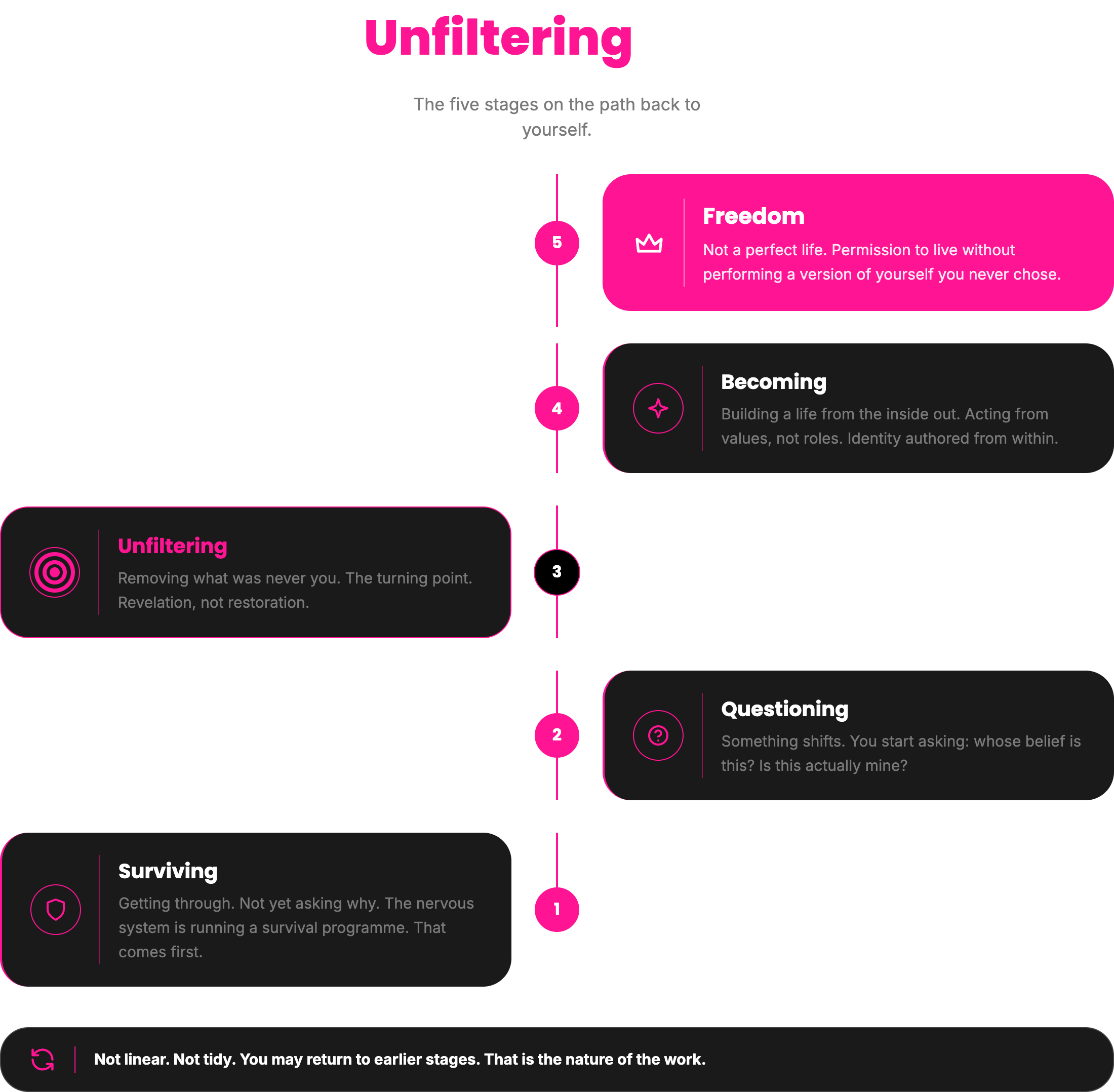
You may move back and forth between stages. This is not failure. It is the nature of the work.
"An abnormal reaction to an abnormal situation is normal behaviour."
Viktor Frankl, Man's Search for MeaningMost models tell you to become aware and then take action. They skip the part that actually matters.
Here is something most change frameworks get wrong.
They tell you that awareness creates change. See the pattern, change the pattern. Understand the belief, replace the belief.
But if that were true, every person who has ever been to therapy would have changed. Every person who has ever read a self-help book would have changed. The information is available. The awareness is often there.
And still, people do not change.
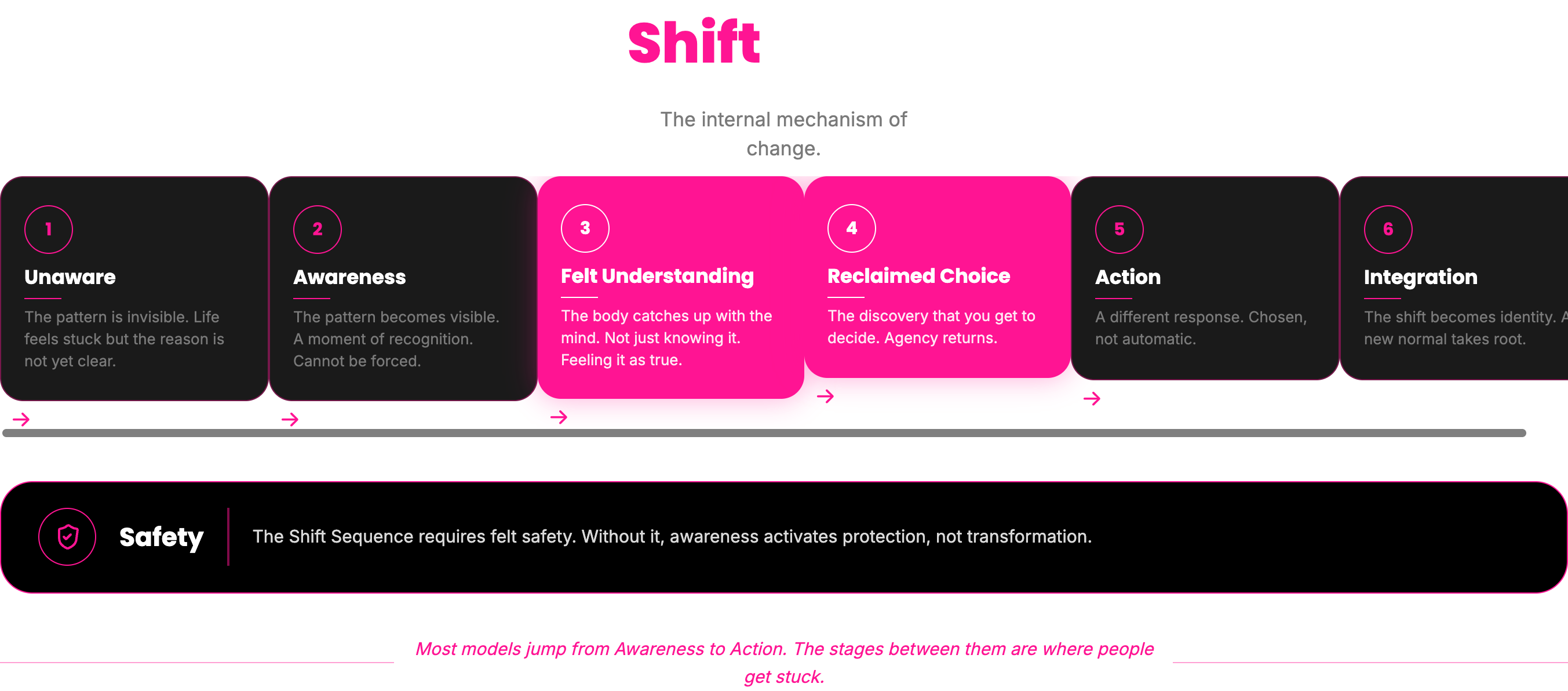
The research tells us why. There are stages between Awareness and Action that most models completely skip. And until those stages happen, action does not stick.
The Shift Sequence maps all six stages.
"In some way, suffering ceases to be suffering at the moment it finds a meaning."
Viktor Frankl, Man's Search for MeaningThe research supports the story. It does not replace it.
I want to be clear about something.
These frameworks did not come from a literature review. They came from my own experience of grief, loss, identity collapse and the long, non-linear process of figuring out what was actually mine.
The research came after. And what I found is that the psychologists, neuroscientists and behavioural scientists had been describing my experience in clinical language for decades. They just were not saying it in a way most people could hear.
My job is not to make HB academic. It is to make it trustworthy.
Hannah's story makes the ideas human. The evidence makes them credible. Both matter.
Nothing in this body of work is a substitute for professional mental health support. If you are in crisis, please reach out to a qualified professional. HB is educational and transformational, not clinical.
If you want to go deeper
These are the texts that underpin the research behind HB's frameworks. I have read them. I have drawn on them. And I recommend them to anyone who wants to understand the evidence behind this work.
- The Body Keeps the Score by Bessel van der Kolk
- Trauma and Recovery by Judith Herman
- Man's Search for Meaning by Viktor Frankl
- Playing and Reality by Donald Winnicott
- In Over Our Heads by Robert Kegan
- The Brain That Changes Itself by Norman Doidge
- Focusing by Eugene Gendlin
- Metaphors We Live By by Lakoff and Johnson
- Post-Traumatic Growth: Conceptual Foundations and Empirical Evidence, by Tedeschi and Calhoun (1996)
- Ego Distortion in Terms of True and False Self, by Donald Winnicott (1960)
Ready to find out where you are in the journey?
Take The Unfiltering Quiz. It is free. It takes five minutes. And it will tell you exactly which stage you are in right now and what that means.
Or if you are ready to work together, apply for The Unfiltering programme.